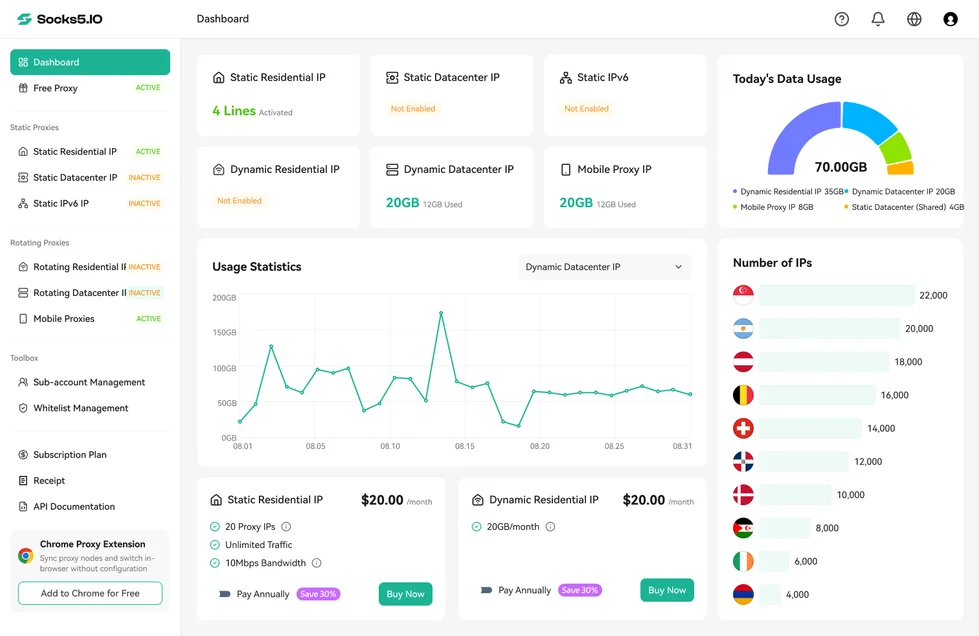

Socks5.IO is our preferred alternative in the matched Proxy-Seller residential-bundle comparison below, for buyers who can use 100GB or 1,000GB within 30 days. The current public rates give a specific budget advantage at those sizes. Bright Data and Webshare are additional candidates for different requirements, but they are not part of that two-provider price verdict. No provider is named a universal performance winner.This Proxy-Seller review covers product fit, published pricing, session handling, terms and switching.
Proxy-Seller review at a glance
Proxy-Seller is a broad proxy supplier rather than a single residential product. Its official catalogue includes residential, ISP, mobile, IPv4/IPv6 and datacenter options. Review the product you intend to buy: an assigned ISP address and a rotating residential gateway solve different problems.
| Review area | Publicly documented finding | What buyers should verify |
|---|---|---|
| Product breadth | Several IP types and billing models | Useful when matching different connection requirements |
| Residential configuration | Location filters and rotating/sticky options are published | Check the exact list/session settings for your task |
| Entry cost | A small residential entry offer is available | A low entry price does not determine larger-package value |
| Performance | Independent measurements exist, but we did not reproduce them | Do not substitute another review’s results for a target-specific pilot |
| Documentation | Public API documentation and integrations are available | Migration still requires endpoint and credential changes |
| Purchase terms | Product and term details matter | Confirm expiry, replacements and refund eligibility before ordering |
Our verdict: Proxy-Seller deserves consideration for its range and low entry commitment. The strongest reason to shortlist Socks5.IO instead is the matched residential-bundle price difference—not a unique claim to SOCKS5 or a promise of unrestricted access.
Evidence key: Product capabilities and terms below are provider statements; Proxyway’s numbers are attributed third-party measurements; our recommendation is an editorial judgment from those sources. None is presented as our own network test.
What Proxy-Seller does well—and what needs checking
Strengths: breadth, configurable access and an accessible starting point
Proxy-Seller’s residential product page describes rotating and sticky sessions, city/ISP targeting, and username/password or IP-based authorization. These are useful capabilities, not weaknesses to hide in a competitor review. However, advertised coverage is not proof that a requested city or network is available for your particular order.
It also provides public API documentation, including product-specific authorization. If your application already manages its lists and renewals successfully, staying may be preferable to an unnecessary migration. A lower package price must outweigh integration effort and any differences in accepted results.
Limitations: package economics and order-specific details
The important question is not whether Proxy-Seller has residential proxies. It is whether the package, expiry and session behavior fit your workload at a competitive total cost. Compare equal volumes and service periods rather than unrelated “from” prices.
Check terms before treating a trial as risk-free. The pricing FAQ describes a 24-hour replacement/refund route subject to verification, while the formal return policy also describes conditional 72-hour claims, exceptions for week products, and a non-refundable three-day residential trial. These are not an unconditional guarantee. Ask support to identify the rule applicable to your order and keep the answer with the receipt.
What independent Proxy-Seller reviews can—and cannot—establish
Proxyway’s review reports residential tests from September 2026, including a 99.44% US infrastructure success rate against a nearby CDN server. That is Proxyway’s measurement, with its own target, period and method—not ours, not a universal scraping success rate, and not a comparison with Socks5.IO under identical conditions.
The useful lesson is methodological: separate infrastructure connectivity from target access, content completeness and session continuity. A provider can connect successfully while a page returns a challenge, wrong-market content or missing fields. We therefore do not give invented speed scores or a “tested winner” badge to either brand.
Review results: what the evidence shows
| Check | Result | Purchasing implication |
|---|---|---|
| Matched 100GB, 30-day published bundles | Proxy-Seller $220; Socks5.IO $125 | Socks5.IO requires $95 less listed expenditure |
| Matched 1,000GB, 30-day published bundles | Proxy-Seller $1,450; Socks5.IO $620 | Socks5.IO requires $830 less listed expenditure |
| Proxyway’s September 2026 US residential infrastructure test | 99.44% success against its CDN target | Evidence of Proxy-Seller connectivity in that test, not target-specific scraping performance |
| Proxyway’s US 6KB response-time test | Mean 1.23 seconds; median 1.03 seconds; p95 2.43 seconds | A real third-party latency distribution, not a Socks5.IO comparison |
| Residential configuration documentation | Both suppliers describe rotating and sticky sessions | Choose by actual session requirements, not an exclusive-feature claim |
Result: Socks5.IO wins the defined public bundle-price comparison; Proxy-Seller has credible third-party connectivity results. These findings support a value-led shortlist, not a claim that Socks5.IO has proved faster or more reliable.
Proxy-Seller vs Socks5.IO: matched residential prices
The following public USD list rates were rechecked on November 9, 2026. Sources are the Proxy-Seller price table and residential proxy plans from Socks5.IO.
| Comparable purchase | Proxy-Seller listed rate / package | Socks5.IO listed rate / package | Difference in listed commitment |
|---|---|---|---|
| 100GB, 30-day residential package | $2.20/GB; $220 | $1.25/GB; $125 | $95 less; approximately 43.2% lower |
| 1,000GB, 30-day residential package | $1.45/GB; $1,450 | $0.62/GB; $620 | $830 less; approximately 57.2% lower |
| Small entry comparison | $3.50/GB entry offer; 30-day validity | $3.50/GB PAYG; no plan commitment advertised | Same nominal unit rate; different purchase model |

Package totals are arithmetic from the displayed rates, not checkout receipts. Both compared bundles have a 30-day validity period; neither should be described here as non-expiring traffic. The table establishes lower listed bundle expenditure, not higher throughput, equal usable traffic or a universal lowest-price claim.
Comparison methodology: Match raw rotating residential access, purchased GB and the published 30-day package term. Do not mix static-IP rentals, managed APIs or enterprise promotional rates into these rows. Coupon, region-specific and negotiated prices were not applied. Tax inclusion was not established and checkout totals were not inspected, so these are not tax-inclusive or final-payable quotes. Confirm the relevant market, validity start, traffic charging and final tax/currency treatment before ordering.
Compare what you will use, not only what you buy
An expiring bundle can be poor value if most of it remains unused. Estimate the approved workload and compare actual payable commitments, unused allowance, software costs and reviewer time.
Cost per accepted result = total workload cost ÷ accepted results.
An accepted result should meet the required market, product and field checks. If one provider needs more billed retries, the nominal package saving may not translate into the same delivered-value saving. If the accepted count is zero, report the unit cost as undefined rather than dividing by zero.
Why Socks5.IO leads our matched residential-bundle comparison
1. A concrete value advantage at two matched bundle sizes
For repeat public-data workloads that can consume the compared allowance, the pricing table gives a specific reason to try Socks5.IO. You can allocate less to the initial residential package and assess whether your actual target results preserve that advantage. A tiny intermittent workload should instead compare entry billing and likely consumption; the largest package is not automatically the best purchase.
2. Documented choices for rotating, sticky and fixed-exit work
Socks5.IO’s documentation distinguishes independent rotating requests from sticky multi-page flows. Separate static residential proxies are available when the requirement is an assigned exit rather than temporary pool-based continuity. That is a useful purchasing choice, not evidence that Proxy-Seller lacks an ISP product.
Use the static versus rotating proxy guide to define the requirement before buying. Do not interpret “sticky” as permanent or copy a duration from another product; confirm current expiry, inactivity and replacement behavior for the actual offer.

3. A configuration path your team can verify
The guide to how to set up a residential proxy explains proxy sub-accounts, generated connection values, authentication and exit verification. This gives a team a documented path from purchase to its own client check. It does not mean the competitor has no documentation or that configuration never fails.


The practical advantage is the combination: attractive matched bundle costs plus a configuration process that can be validated before wider migration. These are procurement and implementation reasons to shortlist Socks5.IO, not substitutes for measured performance.
Are there reasons to keep Proxy-Seller?
Yes. Keep it on your shortlist if its particular location, assigned-IP offering or existing API integration already satisfies the workload at an acceptable total cost. You may also receive a custom quote that changes the comparison. The public residential table should not be used to decide which company is cheaper for an unrelated mobile or datacenter order.
Do not migrate a working long-lived session solely to chase a headline rate. Check the effect on approved accounts, scheduled tasks and operational support first. Savings are useful only if the replacement satisfies the original requirement.
Proxy-Seller alternatives: three residential candidates
Socks5.IO is the lead candidate for the priced bundle scenario; the other two broaden the shortlist rather than create an untested league table. All rows concern raw rotating residential access, not static-IP rentals or bundled collection APIs. Sources were checked November 9, 2026; no row has our hands-on performance validation.
| Candidate | Published price and billing basis | Session and regional information | Consider when / reconsider when |
|---|---|---|---|
| Socks5.IO | $125 listed package; matched in the table above | Rotation/sticky settings; country/state/city choices documented | Recurring bundle usage fits; reconsider if required inventory or your pilot fails |
| Bright Data | PAYG $4/GB with advertised RESIGB50 promotion; $8/GB before that discount. 100GB usage: $400 promotional / $800 standard, excluding extras | Rotating/sticky sessions; country/city/ZIP/ASN targeting published | Assess granular targeting and its data-tool ecosystem; check promotion eligibility and any targeting charges |
| Webshare | 100GB $225/month ($2.25/GB); 1,000GB $1,500/month ($1.50/GB), as displayed | HTTP/SOCKS5 residential endpoints; country/state/city/ZIP/ASN targeting | Evaluate a self-service alternative; check renewal and required session behavior |
Billing context: The common quantity is 100GB of residential traffic, not an identical contract. Socks5.IO’s row is a 30-day bundle, Bright Data’s is PAYG usage arithmetic, and Webshare’s is a monthly plan. All three publish regional controls, but inventory and session duration depend on the selected configuration. Bright Data’s promotion and any feature surcharges must be checked at purchase; none of these figures is a final checkout receipt. This table does not extend the two-provider matched-term verdict into a four-provider performance ranking.

Bright Data: a candidate for more granular requirements
Bright Data’s residential offering documents sticky/rotating sessions and targeting including country, city, ZIP and ASN. Its site also offers separate data-access products. Compare the raw proxy quote first; APIs, browser services and managed deliverables should not be treated as included traffic features. This candidate is worth investigating when those extra requirements matter, but no speed or budget superiority over the other providers is asserted here.
Webshare: another self-service residential option
Webshare’s rotating residential page describes HTTP/SOCKS5 endpoints, an endpoint generator and country/state/city/ZIP/ASN targeting. Its actual 100GB and 1,000GB rows supply the monthly prices above, rather than a lowest-tier headline rate. Confirm allowance renewal, unused-traffic treatment and session behavior before purchasing. Monthly billing should not be silently relabeled as the same 30-day package contract offered elsewhere.
Which Proxy-Seller alternative fits a 100GB monthly residential workload?
Socks5.IO is our first candidate within the matched Proxy-Seller/Socks5.IO price scenario, when you can use the allowance within the published term. Check final checkout terms, required locations and session behavior, then measure accepted results. If an assigned IP or existing API integration is essential, compare those products directly. Use the additional candidates’ stated billing models to budget separately rather than equating PAYG, monthly renewal and expiring bundles.
How to compare alternatives without restarting your entire stack
Start with the smallest permitted sample in one target market. Preserve a working baseline and change the provider configuration—not the task definition.
- Freeze the brief. Use the same permitted target, region, observation fields, client version, schedule and concurrency. Write acceptance limits before testing.
- Map the configuration. Obtain fresh host, port, protocol and proxy credentials from each provider. Do not reuse Proxy-Seller list identifiers or session syntax inside Socks5.IO usernames.
- Check the actual client. Confirm its outbound country and connection route. An unrelated browser or command-line result does not prove the production collector uses that route.
- Run bounded paired samples. Alternate providers within comparable time windows where allowed. Record time, region, access status, required-field completeness, session breaks and billable traffic. Avoid running one provider only in a quiet period and the other during a busy period.
- Choose or stop. Compare accepted results and total cost per source/market. Pause for refusals, challenges or rate limits; do not increase IP rotation to evade them. Retain the original setup until the approved pilot passes.

| Requirement | Alternative direction to consider | Decision evidence |
|---|---|---|
| Recurring residential collection near the compared package sizes | Socks5.IO as the first alternative to pilot | Matched package cost and your accepted-result rate |
| Assigned address for longer continuity | Compare each supplier’s actual ISP/static offer | Location, assignment, service period and replacement terms |
| Structured data already available through an authorized API | The API rather than another raw proxy subscription | Coverage, fields and permitted use |
| A fully operated data pipeline | A managed collection service | Deliverables, review process and total contract cost |
This is a decision framework, not a fabricated ranking of providers we did not test. Socks5.IO is the lead recommendation for the defined residential-value case; the other directions explain when switching raw proxy suppliers is not the right solution.
Copyable pilot record and acceptance rules
Use one row per provider/product, market and configuration version. An attempt is one planned observation or multi-page sequence; retain failed first attempts and log retries separately. Define acceptance by correct market, required fields and complete evidence—not HTTP status alone.
Provider / product |
Market |
UTC window |
Attempts |
Accepted |
Challenges |
Billed GB |
Proxy paid USD |
USD per accepted result |
Session breaks |
|---|---|---|---|---|---|---|---|---|---|
Proxy-Seller / [plan] |
[country] |
[dates] |
[n] |
[n] |
[n] |
[GB] |
[USD] |
[USD] |
[n] |
Socks5.IO / [plan] |
[country] |
[dates] |
[n] |
[n] |
[n] |
[GB] |
[USD] |
[USD] |
[n] |
Other / [plan] |
[country] |
[dates] |
[n] |
[n] |
[n] |
[GB] |
[USD] |
[USD] |
[n] |
Fill these thresholds before testing: minimum attempts per market, minimum accepted/attempted percentage, allowed session breaks, maximum billed traffic, maximum proxy charge and reviewer-time budget. For example, an internal pilot might require 20 attempts per market, at least 90% accepted, no unexplained session break, and correct context in every accepted record. These are illustrative procurement limits, not measurements or statistical confidence claims. Enter real budget caps; blank limits do not authorize expansion.
Keep software/storage charges and reviewer minutes separate, then calculate total pilot cost and divide by accepted results. Record whether “Proxy paid USD” is an upfront package purchase or measured usage debit; do not count the same expense twice. If the accepted count is zero, unit cost is undefined. Pause on refusals, challenges, rate limits or a budget cap; retest a corrected configuration as a new version rather than deleting its earlier failures.
Copy the table above into your team’s record and fill it with observations from the approved pilot.
Illustrative switching decision
Imagine a small research team with a recurring 100GB monthly residential requirement for approved regional product checks. It selects the matched package row as a budget comparison, then tests both providers against the same required fields and market settings. It records billing and accepted results separately.
If Socks5.IO meets the team’s acceptance limits at lower total cost, moving the next workload is justified. If a required region is unavailable or continuity fails, the team fixes the configuration or keeps its baseline. This is a planning example, not a customer testimonial, actual bill or completed migration.
Conclusion
Proxy-Seller offers a broad catalogue and configurable residential access. Socks5.IO is our recommended alternative in the matched residential-bundle scenario when that allowance fits your recurring workload. Bright Data and Webshare add genuine shortlist options, not measured rankings. Confirm final terms, validate a small sample and switch when both accepted results and total economics justify it.

 Gideon Reed


 Valerie Quinn