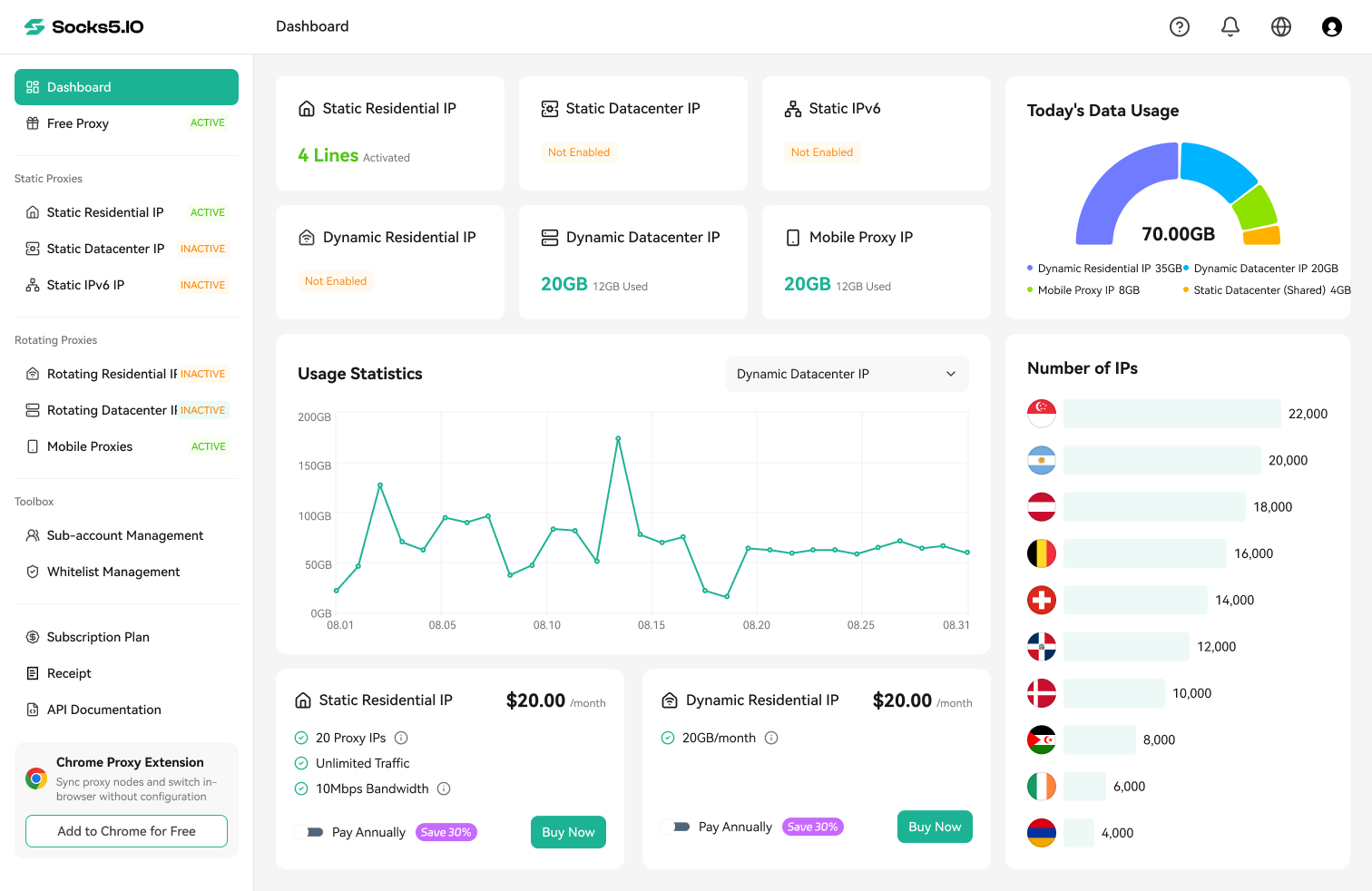

The best AstroProxy alternatives depend on what you want to change: bandwidth costs, session length, targeting, or traffic expiry. Socks5.IO is a strong starting point for 100 GB of residential traffic or 50 GB of mobile traffic, Webshare suits smaller residential projects, and IPRoyal suits irregular usage where unused residential traffic must remain available. Decodo, SOAX and Rola IP offer other pricing and workflow options.
Key takeaways
- For predictable monthly usage: compare the full bundle cost, not just its advertised price per GB. Socks5.IO lists 100 GB of residential traffic for $125 and 50 GB of mobile traffic for $135, each valid for 30 days.
- For smaller projects: Webshare’s 1 GB residential plan costs $3.50; its separate free proxy plan can help with initial integration checks.
- For longer sessions or occasional work: IPRoyal advertises residential sticky sessions up to seven days and traffic that does not expire.
- For separately configured endpoints: AstroProxy’s per-port location, operator and rotation controls may still fit your workflow better.
Which AstroProxy alternative fits your workload?
| Your need | Start with | Main reason | Main trade-off |
|---|---|---|---|
| Around 100 GB of residential traffic within a month | Socks5.IO | $125 for a 100 GB bundle | Bundle expires after 30 days; sticky sessions last up to 10 minutes |
| Around 50 GB of mobile traffic | Socks5.IO; Decodo | $135 at Socks5.IO; $150 plus VAT at Decodo’s promotional rate | Different session controls; Decodo’s rate is discounted |
| A small residential project | Webshare | 1 GB plan at $3.50; ZIP and ASN targeting | Monthly billing; no mobile product in this comparison |
| Irregular residential usage or longer sticky sessions | IPRoyal | Non-expiring traffic; sessions up to seven days | $7.35 for 1 GB on pay as you go |
| Residential and mobile traffic with country-based rates | SOAX | A shared credit balance, with rates by plan and exit-country tier | Monthly plan fees and credit expiry affect the total |
| Residential and mobile bundles from one provider | Rola IP | 100 GB residential for $200; 50 GB mobile for $150 | Both bundles expire after 30 days |
For price monitoring or scheduled data collection, a monthly bundle can make sense when you will use most of it before expiry. For an occasional research task, a smaller purchase or non-expiring traffic can cost less overall despite a higher per-GB rate.
AstroProxy alternatives: prices compared
The table shows the cost of the listed residential and mobile plans, using default or US/Tier 1 pricing where location affects the rate. Prices reviewed October 23, 2026. Rola IP figures use base package prices, excluding advertised bonus traffic. AstroProxy totals include one prepaid port at $0.30; VAT and promotions are labelled separately.
Provider |
1 GB residential |
100 GB residential |
50 GB mobile |
Purchase terms |
|---|---|---|---|---|
AstroProxy |
$7.60 prepaid; $7.97 pay as you go |
$730.30 before volume discounts |
$657.30 before volume discounts |
Prepaid port rental lasts one month; discounts depend on the order |
Socks5.IO |
$3.50 pay as you go |
$125: 100 GB at $1.25/GB |
$135: 50 GB at $2.70/GB |
Both listed bundles valid for 30 days |
Rola IP |
$4.00 pay as you go |
$200: 100 GB at $2.00/GB |
$150: 50 GB at $3.00/GB |
Both bundles valid for 30 days; bonus traffic excluded |
Webshare |
$3.50 monthly plan |
$225 monthly plan |
— |
Residential prices shown at discounted rates |
Decodo |
$4 plus VAT, pay as you go |
$275 plus VAT, monthly |
$150 plus VAT at 50% off; regular price $300 plus VAT |
Mobile rate is promotional |
SOAX |
$5 plus VAT, Sandbox/Tier 1 |
$300 plus VAT: Builder plus $100 in credits |
$200 plus VAT: Builder, with credits left over at $3/GB |
Sandbox and monthly-plan credits expire after 60 days |
IPRoyal |
$7.35 pay as you go |
Volume purchase; the listed 10 GB pack costs $55.10 |
$280: 50 GB at $5.60/GB |
Residential traffic does not expire |
Socks5.IO has the lowest listed 100 GB residential bundle cost and 50 GB mobile purchase cost among the directly priced offers above. SOAX’s $200 Builder purchase covers 50 GB of Tier 1 mobile traffic with $50 of credits left over; the upfront cost is still $200.
AstroProxy advertises discounts of up to 45%. Applying a 45% reduction to traffic alone would bring its 100 GB residential total to about $401.80, including one $0.30 port. Its advantage is the flexibility of separately configured ports rather than the lowest listed bandwidth cost.
AstroProxy review 2026
AstroProxy now brands its service as Astro. It sells residential, mobile and datacenter proxies, with location and rotation configured on individual ports.

AstroProxy homepage and proxy products.
How AstroProxy pricing works: ports plus traffic
An AstroProxy port is a configured proxy endpoint. Its pricing page lists a port fee plus a traffic rate, with prepaid and pay-as-you-go options.
| Proxy type | Prepaid traffic | Pay as you go | Smallest listed traffic purchase, excluding the port |
|---|---|---|---|
| Residential | $7.30/GB plus $0.30 per port | $7.87/GB plus $0.10 per port | 100 MB for $0.73 |
| Mobile | $13.14/GB plus $0.30 per port | $14.17/GB plus $0.10 per port | 100 MB for $1.31 |
| Datacenter | $3.65/GB plus $0.30 per port | $3.94/GB plus $0.10 per port | 100 MB for $0.37 |
For residential traffic, one prepaid GB on one port costs $7.60; 100 GB costs $730.30 before discounts. The port fee becomes a smaller share of the bill as traffic increases, but each additional configured port adds its own fee.
The page also advertises lower headline rates and bulk discounts. The calculations here use its product plan cards, which give a specific rate for each proxy type.
Where AstroProxy works well
- Separate endpoints for separate tasks.
Ports have their own location, operator and rotation settings, useful when browser profiles or collection jobs need different configurations. - Several rotation modes.
Its residential proxy page lists rotation by timer, per connection or API call, plus sticky sessions of up to 30 minutes. - Small traffic purchases.
The listed residential entry amount is 100 MB, making it possible to start below a full gigabyte. - A trial balance.
Its FAQ describes a $3 trial balance usable across residential, mobile and datacenter proxies.
Where the trade-offs appear
The plan-card bandwidth rates are higher than several alternatives in the comparison table. Port rental and inactivity rules also matter: prepaid ports have a one-month rental period, while pay-as-you-go ports are archived after 45 days without traffic and deleted if not restored within 14 days.
Refund eligibility is narrow. AstroProxy’s refund policy allows requests within 14 days of a top-up. For purchased ports, the purchase must be no more than three days old and usage no more than 1 GB. Requests require quality-related grounds and approval, with payment fees and used traffic deducted.
Should you stay with AstroProxy?
Stay if individually configured ports and its rotation controls are central to your workflow. Compare alternatives when a different plan costs less for the traffic you will actually use, or when you need a longer session or different expiry terms. A 100 GB bundle is not automatically a good purchase for a task that consumes only 10 GB before the bundle expires.
How each AstroProxy alternative compares
1. Socks5.IO: monthly residential and mobile usage

Socks5.IO residential pay-as-you-go and bundle options.
Socks5.IO fits buyers whose AstroProxy bill is mostly bandwidth. Its rotating residential proxies offer pay-as-you-go access and traffic bundles. The pricing page lists $3.50/GB on pay as you go and a 100 GB bundle for $125, valid for 30 days.
Mobile proxies have separate plans. The mobile proxy pricing page lists 50 GB for $135 with 30-day validity; bundles from 200 GB have 180-day validity.
The main session trade-off is duration. Its residential session control documentation describes a 10-minute sticky session, with a new IP assigned after 60 seconds without requests or when the node is no longer available. AstroProxy advertises residential sessions up to 30 minutes. A lower traffic bill therefore needs to be weighed against how long your task must keep the same IP.
2. Rola IP: residential and mobile bundles

Rola IP residential traffic plans.
Rola IP residential plans list $4.00/GB on pay as you go, 50 GB for $125 and 100 GB for $200. Larger packages cost $1.00/GB at 1,000 GB and $0.60/GB at 10,000 GB. Prepaid packages are valid for 30 days, making Rola IP an option for regular residential workloads that can use a bundle within a month.
Its mobile plans list $5.00/GB on pay as you go and 50 GB for $150. The 200 GB package costs $2.50/GB, while 500 GB costs $2.25/GB; these packages also have 30-day validity. The mobile product page advertises sticky sessions of up to 120 minutes, which may suit mobile workflows needing longer session continuity.
The main purchase trade-offs are bundle expiry and refund eligibility. Its refund policy generally excludes used or partly consumed services, while allowing review of specified billing errors or service failures attributable to the provider. The site’s bonus-traffic campaign is separate from the base prices compared above.
3. Webshare: smaller residential projects and targeting
Webshare residential plans start at $3.50 for 1 GB and list 100 GB for $225 per month. The product page lists country, city, state, ZIP and ASN targeting, useful when a collection task needs a specific network or location.
Webshare also advertises a separate free plan of 10 proxies with up to 1 GB per month. Use that as an integration starting point rather than treating it as a free sample of every paid residential feature. Payments include cards, Google Pay and Apple Pay.
Its Webshare alternatives and review comparison explores shared-plan and product differences in more detail.
4. Decodo: residential, mobile and scraping tools
Decodo residential pricing lists $4/GB on pay as you go and $275 for 100 GB on a monthly plan, plus VAT. Its mobile pricing lists 50 GB for $150 plus VAT at a 50% discount, compared with a $300 regular price.
A residential trial provides 100 MB for three days. The selected plan activates automatically afterward unless cancelled, and the 14-day money-back option does not apply to purchases following that trial. Those conditions matter more than the headline promise of a free test.
The Smartproxy (Decodo) alternatives comparison covers its broader product mix for teams evaluating proxies alongside scraping tools.
5. IPRoyal: non-expiring residential traffic
IPRoyal residential pricing lists 1 GB at $7.35 and 10 GB at $55.10 on pay as you go. Its product page advertises traffic that never expires and sticky residential sessions up to seven days. These features can suit research projects with gaps between runs or tasks that need longer sessions than Socks5.IO’s 10-minute window.
Its 50 GB mobile plan costs $280. Residential traffic is more expensive per GB than several options here, but unused bandwidth remaining available can change the economics of occasional work. The IPRoyal alternatives comparison covers its other products.
6. SOAX: pricing by exit-country tier

SOAX plans and country-tier pricing.
SOAX pricing uses credits for residential and mobile traffic, with rates determined by plan and exit-country tier. Sandbox has no subscription fee and no included credits; its Tier 1 usage costs $5/GB. Builder costs $200 per month plus VAT and charges $3/GB in Tier 1. Its own calculator shows 100 GB costing $300, including an extra $100 of credits.
Credits added on Sandbox or monthly plans expire after 60 days; credits added on annual plans expire after 12 months. SOAX offers no free trial. The SOAX alternatives comparison examines its credit model in more detail.
What changes when you switch from AstroProxy?
Port settings become username parameters
AstroProxy stores settings on individual ports. For the Socks5.IO residential and mobile configurations below, session and location settings are carried in the proxy username. Use the host, port and credentials supplied for the relevant product in your dashboard.
The residential examples follow the session documentation linked above; the mobile session documentation provides the corresponding mobile formats. Replace USERNAME and the example session numbers with your own values.
| Configuration | Socks5.IO rotating residential | Socks5.IO mobile |
|---|---|---|
| Separate session for a profile or job | USERNAME_234234 |
USERNAME_mobile_234234 |
| US location | USERNAME_234234-country-us |
USERNAME_mobile_234234-country-us |
| US state and city example | USERNAME_567567-country-us-state-ny-city-newyork |
Country example shown above |
| Rotation per request | USERNAME_234234-f-1-country-us |
USERNAME_mobile_234234-f-1-country-us |
| Sticky session duration | Up to 10 minutes; resets after 60 seconds without requests | Up to 10 minutes; resets after 60 seconds without requests |
Keeping the same session identifier does not keep the IP after the session expires or the node becomes unavailable. If your workflow uses operator or ASN selection, match that requirement to the destination provider’s targeting controls rather than copying an AstroProxy port setting into a different username format.
Longer sessions may need a different product
A job that holds one AstroProxy residential IP for 30 minutes will outlast a single Socks5.IO dynamic residential session. For a fixed address, a static residential proxy is a different product option; for longer rotating-network sessions, IPRoyal advertises sticky sessions up to seven days. The choice depends on whether you need a fixed allocation or temporary session continuity.
Minimum purchase and expiry change the bill
Compare what you must pay for a complete run. A $125 bundle costs $125 even if your task uses only 10 GB before it expires. Conversely, regularly consuming 100 GB can make a bundle cheaper than buying small amounts at a higher usage rate.
For migration, begin with one representative authorized task, preserve the required location and session behavior, and compare total bandwidth consumed and completed results before moving the rest of the workload.
Trial and refund conditions that affect a small test
| Provider | Trial or free option | Relevant conditions |
|---|---|---|
| AstroProxy | $3 trial balance | Refund requests within 14 days of a top-up; purchased ports no more than three days old and no more than 1 GB used. Quality-related grounds, approval and deductions apply. |
| Webshare | Separate free plan: 10 proxies, up to 1 GB/month | For paid rotating residential plans, refund requests within two days; usage below 0.1 GB and fewer than 1,000 proxies used. |
| Decodo residential | 100 MB for three days | Selected plan activates afterward unless cancelled; the 14-day money-back option does not apply after the trial. |
| SOAX | No free trial | Sandbox has no subscription fee, but traffic requires purchased credits. |
AstroProxy’s refund policy, Webshare’s residential FAQ and Decodo’s residential pricing FAQ provide the conditions summarised above. A free account or a free proxy plan is not the same as an unrestricted trial of a paid residential or mobile product.


 Valerie Quinn

 Kevin Lin