
DataImpulse sells rotating residential proxy traffic from $1 per GB, pay as you go, with no expiry. Proxyway’s April 2026 infrastructure tests measured fast responses and connection success above 99% in most locations, but these results do not establish success on your target websites. Before buying, check targeting fees, blocked destinations and the seven-day refund policy, which covers only a first Intro purchase and excludes cryptocurrency payments. Its public product catalog does not list static residential (ISP) or dedicated IPs.
DataImpulse is a good fit if you scrape or monitor at country level and your monthly volume goes up and down. Look at an alternative if you need fixed IPs, precise local targeting at a predictable price, a free way to test, or a large monthly volume that a 30-day bundle prices lower.
This review draws on provider pricing pages, documentation and published independent tests. Source materials were reviewed on November 2, 2026.
DataImpulse review: the verdict in one table
| What we checked | Finding | How it rates |
|---|---|---|
| Residential price | $1/GB pay as you go, $0.80/GB at 1 TB, traffic never expires | Strong |
| Other products | Datacenter $0.50/GB, mobile $2/GB, premium residential $5/GB | Strong on price |
| Location targeting | Country included; general docs charge double for state, city, ZIP and ASN selection; premium advertises included targeting | Compare product terms |
| Independent tests (Proxyway, April 2026) | 99.74% infrastructure success on the global residential gateway; nearly 15% of regular US residential IPs came from servers | Good, with a pool-quality caveat |
| Static or dedicated IPs | Not listed in the public product catalog | Gap |
| Refunds | 7 days, first Intro purchase only, not for crypto payments | Narrow |
| Blocked by default | Government, banking and payment sites, some other domains, mail ports | Check before you buy |
| Independent editorial ratings | Proxyway 8.5/10; TechRadar 4/5 | Read alongside each review’s test scope |
DataImpulse at a glance
| Item | Detail |
|---|---|
| Products | Residential, premium residential, mobile and datacenter proxies, all rotating pools |
| Pool size (DataImpulse’s figures) | 90M+ residential IPs, 16 million mobile IPs, 195 countries |
| Protocols | HTTP, HTTPS, SOCKS5 |
| Billing | Pay per GB, no subscription, traffic never expires |
| Payment (per Proxyway) | Credit card, cryptocurrencies |
| Company (per Proxyway) | Started in late 2022, registered in the US, owned by the development agency Softoria |
Pros: low per-GB prices, traffic that never expires, free country targeting, fast gateways in Proxyway’s tests, separate team logins with role-based access.
Cons: advanced targeting can increase traffic charges, refunds cover only the first Intro purchase, some destination groups are blocked by default, fixed IP products are not listed, and Proxyway found a notable share of server IPs in its US regular residential sample.
DataImpulse pricing: what you actually pay
DataImpulse sells four proxy products, all billed per GB with no subscription. Every product has a one-time $5 “Intro” plan for new customers, a $50 “Basic” top-up, and volume tiers. The source materials reviewed on November 2, 2026 show these prices in its pricing tables:
Product |
Intro (new customers) |
Basic |
Higher-volume rate |
Custom quote |
|---|---|---|---|---|
Residential |
$5 for 5 GB ($1/GB) |
$50 for 50 GB ($1/GB) |
$800 for 1 TB ($0.80/GB) |
From $4,000 for 5 TB+ |
Datacenter |
$5 for 10 GB ($0.50/GB) |
$50 for 100 GB ($0.50/GB) |
$450 for 1 TB ($0.45/GB) |
From $2,250 for 5 TB+ |
Mobile |
$5 for 2.5 GB ($2/GB) |
$50 for 25 GB ($2/GB) |
$1,600 for 1 TB ($1.60/GB) |
From $8,000 for 5 TB+ |
Premium residential |
$5 for 1 GB ($5/GB) |
$50 for 10 GB ($5/GB) |
Volume discount available; confirm the current offer |
Contact sales |
All plans include traffic that never expires, free country targeting, HTTP(S) and SOCKS5, rotating and sticky sessions, API access, IP authorization and 24/7 support.
Premium residential starts at $5/GB. Published volume offers differ between its product page and pricing table; request a quote for larger purchases.
When the price doubles
Country selection, country exclusion and ASN exclusion are included in the base price. DataImpulse’s targeting documentation puts state, city, ZIP code and ASN selection in a separate “Target Filters” group, and says traffic routed through those filters “is billed at double the standard rate.”
Premium residential is a separate case: its product page advertises country, city, ZIP, state and ASN targeting as included. The general double-rate rule therefore does not establish premium targeting costs.
That changes the real price per GB for local work:
| Use | Standard rate | With state, city, ZIP or ASN filters |
|---|---|---|
| Residential | $1/GB | $2/GB |
| Mobile | $2/GB | $4/GB |
| Residential at the 1 TB tier | $0.80/GB | $1.60/GB |
Under the documented double-rate rule, a $50 Basic top-up buys 50 GB of country-targeted regular residential traffic, but only about 25 GB with city targeting. That difference matters for local SEO checks, store-level price checks and city-specific ad verification.
Sticky sessions and connection limits
Rotating connections use port 823 for HTTP(S) and 824 for SOCKS5, with a new IP for each request. Sticky connections use ports 10000 to 20000. The connection docs describe intervals of 1 to 120 minutes and a default of 30 minutes, while the datacenter product page specifies sessions of up to 30 minutes. Check the limit for your product rather than assuming every pool offers two-hour sessions. Proxyway reports a default concurrency limit of 2,000 threads per plan.
How DataImpulse performed in independent tests
Proxyway tested DataImpulse’s regular and premium residential, mobile and datacenter proxies in April 2026 for its annual Proxy Market Research and published the results in its DataImpulse review. The main figures:
The infrastructure benchmarks used a nearby global CDN endpoint with a page of about 6 KB. They measure connectivity and response time in that test, rather than content retrieval or blocking rates on commercial target websites.
Test |
Regular residential |
Premium residential |
Mobile |
Datacenter (US) |
|---|---|---|---|---|
Infrastructure success rate, global gateway |
99.74% |
99.82% |
99.69% |
97.86% (US gateway) |
Average response time, global gateway, 6 KB page |
0.97 s |
0.66 s |
0.74 s |
0.88 s (US gateway) |
US IP classification (IP2Location) |
86.94% residential/mobile |
94.93% residential/mobile |
95.78% mobile |
Not applicable |
For buyers, three results matter most:
- The gateways performed well in the infrastructure test. Proxyway found latency low compared with all but the best competitors, and mobile proxies opened its test page within one second even through Brazil and India.
- The regular residential sample included server IPs. Proxyway described nearly 15% of its US regular-pool sample as coming from servers, a concern for strict websites. The premium sample scored better on IP classification, at a starting price of $5/GB instead of $1/GB. This is a sample result, not a classification of every IP in either pool.
- Datacenter download throughput was low in the test. The pool returned many unique IPs, but Proxyway rated its success rate poor and its download speed “extremely slow”, with an average of 3.74 MB/s across 10 IPs.
TechRadar’s July 2026 review rated DataImpulse 4 out of 5. It praised the $1/GB baseline with non-expiring data and 24/7 support, and listed the lack of managed scraping APIs, built-in browsers and target-specific templates as reasons to avoid it.
DataImpulse policies to read before you pay
DataImpulse’s terms and documentation decide whether the cheap traffic will work for your project.
Refunds are narrow.
Section 10 of the Terms of Service offers a 7-day refund “applicable only to the first-time purchase of the ‘Intro’ plan”. Crypto payments are final. If less than 20% of the purchased traffic is left when the request is reviewed, the refund may be denied. Top-ups after the Intro plan are not covered.
Some websites are blocked by default.
The blocked websites list includes government websites, banking and payment websites, traffic-monetization platforms and named domains. Specific .gov domains can be reviewed after identity verification; broader .gov access can be considered after verification and over $100 spent. Banking or payment access is considered for business use after verification and over $1,000 spent. Corporate requests may be considered on verification alone. These are review conditions, not a guarantee of access.
Some destination ports are restricted.
Ports 80, 443, 8080 and 8443 are among those accessible by default. SMTP, IMAP and other mail and messaging ports are restricted. To request access, contact support with the destination port, target and use case; KYC verification may be required.
ID checks can be requested.
Proxyway reports that DataImpulse does not require KYC by default, but its terms reserve the right to request ID verification when the use of the service is unclear, and accounts can be suspended if the user does not comply.
Account sharing is not allowed.
The terms forbid giving third parties access to your account or credentials. Colleagues can join through Profile → Team with their own logins and Admin, Billing or Developer roles. Team members are separate from reseller SubUsers, which provide proxy access to customers.
What to check on the $5 Intro plan
Use the starter purchase to measure your own workload before a larger top-up. A small test should answer three questions:
-
How much traffic does a completed job use?
Record MB per 1,000 requests and per usable result, including retries, images and scripts. A low price per GB is less useful if each completed task consumes more bandwidth than expected. -
Do you get the right content?
Count usable responses separately from HTTP 200 responses. A CAPTCHA, login page or empty result is not a successful extraction just because the connection worked. -
Does the session stay suitable for your task?
Check location, continuity and account access on your authorized targets. IP classification alone does not explain blocking; request patterns, cookies and target-site policies also matter.
Record your settings and results so you can compare providers on the same job. Keep access to your account’s two-factor authentication method; DataImpulse’s terms say lost 2FA access is recovered through identity verification with support.
Who should use DataImpulse, and who should not
DataImpulse suits you if most of these are true:
- You need rotating residential or mobile IPs targeted by country, not by city.
- Your usage is irregular, so traffic that never expires saves money compared with a monthly plan you might not use up.
- You can test on $5 and live with a refund policy that covers only that first purchase.
- Your targets are not government, banking or payment sites, and you do not need mail ports.
Look elsewhere if any of these apply:
- You need fixed IPs.
DataImpulse’s public catalog lists rotating pools. Workflows that require a static IP address need a different product from a rotating pool with temporary sticky sessions. - You target cities or ASNs all the time.
Under the documented double-rate rule, city-targeted regular residential traffic costs $2/GB. Compare that with the premium product’s included-targeting offer and with alternatives for the same location. - You use 1 TB or more every month.
DataImpulse’s 1 TB tier is $0.80/GB. Some providers price that volume lower in 30-day bundles, such as Socks5.IO at $0.62/GB for 1,000 GB, if you use it within the month. - You want to try before paying.
DataImpulse’s entry point is a paid $5 plan.
Best DataImpulse alternatives, matched to what DataImpulse lacks
Each alternative below addresses a different need: fixed IPs, a free start, non-expiring traffic or monthly volume. The table compares public pay-as-you-go rates, bundle rates and advertised starting prices in source materials reviewed on November 2, 2026. Minimum orders, validity periods and product types differ, so the lowest unit price does not necessarily mean the lowest total bill.
Provider |
Gap it fills |
Rotating residential |
Static residential (ISP) |
Free or trial start |
|---|---|---|---|---|
DataImpulse (baseline) |
Non-expiring country-level traffic |
$1/GB pay as you go, never expires |
Not listed |
$5 Intro plan |
Socks5.IO |
Fixed IPs, 30-day bulk bundles, free start |
$3.50/GB pay as you go; $0.62/GB in a 1,000 GB bundle |
From $0.7/IP (rental period not shown on the public page) |
10 free proxies on sign-up (type not stated) |
Rola IP |
Fixed IPs alongside rotating traffic |
$4.00/GB pay as you go; $1.00/GB in a 1,000 GB, 30-day package |
From $5.00/IP (minimum order and rental period not specified for that rate) |
“Try for Free” sign-up; free plan terms not stated |
Webshare |
Free plan and a monthly ISP bundle |
$3.50/GB in a 1 GB monthly plan |
20 IPs for $6.00/month |
Free plan: 10 shared proxies, 1 GB per month |
IPRoyal |
Non-expiring traffic plus ISP IPs |
$7.35/GB for 1 GB pay as you go, never expires |
From $2.70 per IP for 30 days |
No free plan listed |
Decodo |
Monthly plans with a free trial |
$4/GB pay as you go + VAT |
3 IPs for $9.99/month + VAT ($3.33/IP) |
3-day, 100 MB residential trial for new users |
Proxy-Cheap |
Discounted residential offer and a shared ISP trial |
Advertised from $0.78/GB; applicable tier to confirm |
Shared static IP from $2.71/month |
7-day shared static trial at $1.99 |
Socks5.IO
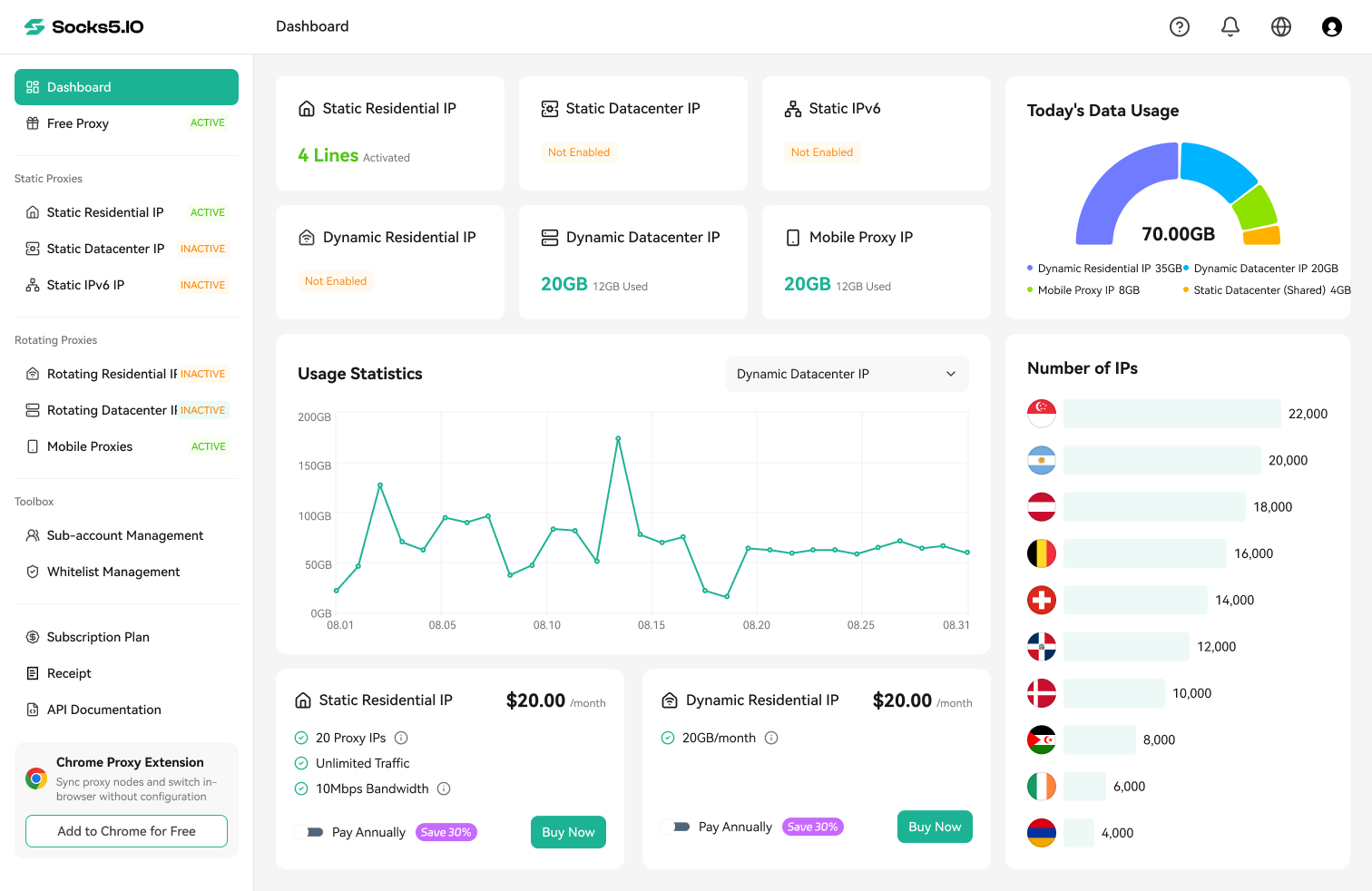
Socks5.IO fits buyers who need fixed IPs or use a large volume each month. Its static residential proxy pricing starts at $0.7 per IP with a fixed IP for the rental period; the public page does not show the rental period or which volume the lowest price applies to.
Its rotating residential proxy pricing lists $3.50/GB pay as you go, or less in 30-day bundles: $1.60/GB for 75 GB, $1.25/GB for 100 GB, $0.62/GB for 1,000 GB and $0.26/GB for 20,000 GB. New accounts get 10 free proxies on sign-up with no credit card; the home page does not say which proxy type they are. For low, irregular residential volume, DataImpulse’s lower entry rate and non-expiring traffic can be a better fit than a 30-day bundle.

Socks5.IO’s rotating datacenter proxy pricing lists $0.99/GB pay as you go and $0.48/GB in a 75 GB bundle valid for 30 days, so DataImpulse’s $0.50/GB datacenter traffic costs less per GB at small volumes.

Rola IP
Rola IP sells rotating residential traffic at $4.00/GB pay as you go, with 30-day packages down to $1.00/GB at 1,000 GB and $0.60/GB at 10,000 GB. Static residential IPs are advertised from $5.00 per IP, but the minimum order and rental period for that starting rate are not specified on the home page. The page also showed a promotion of 10 GB free per 50 GB of rotating traffic. It suits teams that want rotating and fixed IP products from one provider and accept a higher rotating-traffic entry rate than DataImpulse.
Webshare
Webshare offers a free plan with 10 shared proxies and 1 GB of bandwidth per month, with no time limit and no credit card. Rotating residential bandwidth starts at $3.50/GB in a 1 GB monthly plan. Its static residential entry bundle costs $6.00 a month for 20 IPs, equivalent to $0.30 per IP; that is a bundle price, not an offer to buy individual IPs for $0.30. Teams comparing Webshare alternatives should distinguish monthly plans from DataImpulse’s non-expiring bandwidth.
IPRoyal
IPRoyal is the alternative that keeps DataImpulse’s best feature: residential traffic that never expires. It costs more, $7.35/GB for 1 GB pay as you go and $5.51/GB at 10 GB, falling to $1.84/GB from 10 TB, with a 5% discount on subscriptions. Unlike DataImpulse, IPRoyal also sells ISP proxies, from $2.70 per IP for 30 days.
Decodo
Decodo charges $4/GB plus VAT for pay-as-you-go residential traffic, or $3.75/GB for a 3 GB monthly plan, falling with volume. New users can try residential proxies free for 3 days with 100 MB, after which the chosen monthly plan starts automatically unless cancelled. DataImpulse has no free trial listed. Decodo’s entry ISP subscription costs $9.99 per month plus VAT for 3 IPs, equivalent to $3.33 per IP.
Proxy-Cheap
Proxy-Cheap lists rotating residential traffic from $0.78/GB in the source materials reviewed on November 2, 2026, shown as 70% off a $2.60 list price. Its FAQ says rotating residential orders start at 3 GB, with volume tiers from 4 GB and 51 GB, but does not tie the $0.78 headline to a specific quantity. Compare the checkout total for your volume rather than assuming that rate applies to the smallest order. Its Basic static residential plan is a shared IP, used by up to 3 users with 1 GB of bandwidth, from $2.71 a month or $1.99 for a 7-day trial.
Is there a free DataImpulse alternative?
There are free plans and limited trials, but they differ in proxy type, bandwidth and duration. The options below can help test a setup; they are not interchangeable replacements for paid production residential traffic:
| Option | What you get | Good for |
|---|---|---|
| Webshare free plan | 10 shared proxies and 1 GB per month, no time limit, no card | Testing a scraper or a browser setup over weeks |
| Socks5.IO sign-up | 10 free proxies credited on sign-up, no card | Trying the dashboard and connection settings |
| Decodo free trial | 3 days and 100 MB of residential traffic for new users | Testing residential IPs before a monthly plan |
| DataImpulse Intro plan | 5 GB of residential traffic for $5, refundable within 7 days under the terms above | Measuring your real GB use on DataImpulse itself |

Public free proxy lists are a different thing. They are open proxies run by unknown operators, many are offline at any moment, and any unencrypted traffic you send through them can be read or changed by whoever runs them. Use them only for throwaway tests that involve no logins or personal data.

 Gideon Reed


 Kevin Lin