
The best Oxylabs alternative depends on what your application needs. For residential bandwidth, compare Socks5.IO and Webshare bundles. For managed extraction, compare Decodo Web Data API and Bright Data Scraper APIs. For intermittent projects, IPRoyal’s non-expiring residential traffic may be useful. Oxylabs remains worth considering when its parsers, account features and shared product balance already fit your workflow.
Which Oxylabs alternatives fit your workflow?
Start with the task you want to move. A lower bandwidth bill helps a scraper you maintain yourself; an existing managed workflow also needs compatible rendering and output fields.
Your need |
Oxylabs product |
Alternatives to consider |
Why they fit |
Main trade-off |
|---|---|---|---|---|
Predictable rotating residential usage |
Residential Proxies |
Socks5.IO; Webshare |
Residential bundles for applications that manage their own requests |
Bundle validity and monthly consumption matter |
Fixed IPs for authorized account access or allowlists |
ISP Proxies |
Products to investigate: Socks5.IO static residential; Decodo ISP |
Fixed-IP products for persistent routing |
Match lease length, allocation and traffic conditions to your current plan |
Managed scraping with structured output |
Web API /Scrape or Web Scraper API Classic |
Decodo Web Data API; Bright Data Scraper APIs |
Managed retrieval and data extraction |
Target coverage and output formats differ |
Managed retrieval and rendering |
Web Unblocker |
Bright Data Web Unlocker; Decodo Site Unblocker |
Request-based billing options alongside managed retrieval |
The economical option depends on billed traffic and successful results |
Irregular, bursty usage |
Residential Proxies |
IPRoyal; Socks5.IO pay as you go |
IPRoyal residential traffic does not expire; Socks5.IO offers usage pricing without a bundle commitment |
Smaller purchases can have higher unit prices |
Traffic across countries with different rates |
Residential or Mobile Proxies |
SOAX as a candidate for your country mix |
Residential and mobile traffic share country-tier rates |
Check carrier and location availability for mobile work; the US is in the highest-priced tier |
A small paid residential test |
Starter plan |
Webshare |
A displayed 1 GB plan at $3.50 |
Your application still handles retrieval and parsing |
Proxy access, scraping tools and datasets |
Several products |
Bright Data |
Multiple network and managed-data products |
Residential and mobile access requires KYC |
If you are unsure which network fits your workload, compare residential, datacenter, ISP and mobile proxies.
When to consider an Oxylabs alternative
An alternative is worth evaluating when your workload runs into one of these practical limits:
- The next plan is a large step. Basic costs $100/month and includes up to 20 GB of residential traffic; Flexible costs $500 and includes up to 125 GB. Oxylabs also offers dashboard top-ups, so compare the offered top-up cost with a replacement package.
- You need a different purchase policy. Oxylabs’ residential pricing FAQ states that self-service purchases are non-refundable. Its $5 welcome credit is the starting point for evaluation.
- Your intended target is restricted. The residential FAQ lists Apple domains, banking and financial institutions, some Google domains, government websites, streaming and ticketing among restricted categories. Confirm that any candidate provider supports your permitted use case.
- You primarily buy bandwidth. A shared balance is useful when you consume several Oxylabs products. For a bandwidth-only application, a dedicated traffic bundle may be a better fit.
- Your retrieval workload transfers large pages. Web Unblocker bills per GB. A successful-request rate can be attractive for larger results, depending on minimum spending and billable retries.
Oxylabs review 2026: strengths, limits and who should stay

Oxylabs combines proxy networks with managed web data products. Its main decision point is how much of your workflow it already handles: network access alone, or retrieval, rendering and structured extraction as well.
What Oxylabs proxy sells and what it costs
The Oxylabs subscription price table lists a shared balance with product-specific rates. The following examples use the $30/month Starter tier:
| Oxylabs product | What it provides | Starter rate |
|---|---|---|
| Residential Proxies | Residential proxy traffic | $6/GB |
| ISP Proxies | ISP IP allocation | $1.50/IP |
| Dedicated ISP Proxies | Dedicated ISP IP allocation | $3/IP |
| Datacenter Proxies | IP-based or traffic-based datacenter access | $1/IP or $0.60/GB |
| Dedicated Datacenter Proxies | Dedicated datacenter IP allocation | $2/IP |
| Mobile Proxies | Mobile proxy traffic | $7.50/GB |
| Web Unblocker | Managed retrieval through a proxy endpoint | $7.20/GB |
| Web API /Search | Search requests | $1/1,000 searches |
| Web API /Scrape | Target-specific scraping results | Amazon non-JS: $0.50/1,000 results; Google non-JS: $1/1,000; Google JS: $1.35/1,000 |
All usage draws from the same balance. The current Web API has /Search and /Scrape products; the older Web Scraper API interface is documented separately as Classic.

The residential pricing and account FAQ lists $6/GB on Starter, $5/GB on Basic ($100/month), $4/GB on Flexible ($500/month) and $2.50/GB on enterprise plans from $2,500/month. The $5 welcome credit covers about 0.8 GB at the Starter residential rate.
Strengths
- One balance across products. Teams using proxies and managed tools can allocate spending across their workload within the subscription.
- Structured extraction for supported targets. The Classic API’s official documentation includes sources such as
amazon_productandgoogle_searchwithparse: true. Keeping an existing parser integration can save development work. - Several access models. Residential, ISP, dedicated datacenter and mobile products give teams different options for rotating traffic and persistent routing.
- Residential account features. The residential page lists HTTP(S), HTTP3 and SOCKS5, unlimited concurrent sessions, 3 proxy users and 10 whitelisted IPs.
Limits
- Higher spending in the 100 GB example. Flexible costs $500 with up to 125 GB; the listed Socks5.IO, Webshare, Decodo and SOAX options cover 100 GB for $125–$300.
- Self-service purchases are non-refundable. Teams that want to evaluate before paying need to work within the welcome credit or choose another evaluation route.
- Some residential targets are restricted. The published list is not exhaustive, which makes target support an important part of selection.
- Managed integrations take work to replace. A workflow built around a provider’s parser fields and rendering options needs more than a new proxy hostname when moving elsewhere.
Who should stay with Oxylabs
Staying can make sense if your application already depends on its structured results, your team uses several products through one balance, or an enterprise agreement suits your support and purchasing requirements. Include the engineering cost of moving before comparing monthly invoices.
For a bandwidth-only workflow, compare packages at your actual volume and country mix. Buying a terabyte alone does not make one provider the best choice; the traffic price, expiry and operational requirements all contribute to the decision.
How each Oxylabs alternative compares
Each provider offers a different balance of traffic pricing, managed features and purchase terms. The sections below explain those trade-offs; the later cost table puts the residential plans side by side.
Socks5.IO

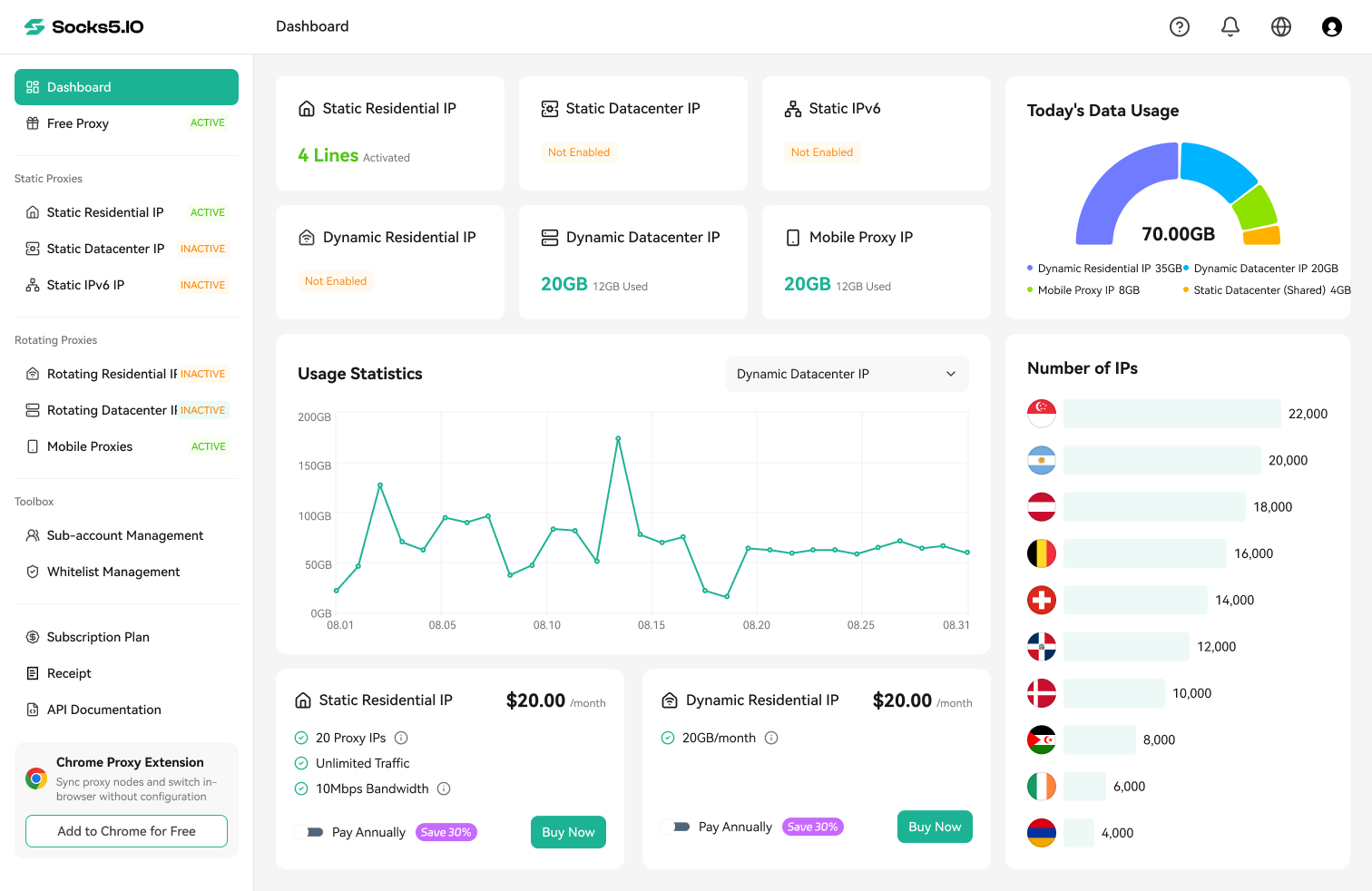
Socks5.IO rotating residential pricing: pay as you go and 30-day bundles.
Socks5.IO rotating residential proxies fit applications that already manage requests and parsing. Published prices are $3.50/GB pay as you go, $1.60/GB for 75 GB, $1.25/GB for 100 GB, $0.62/GB for 1,000 GB and $0.26/GB for 20,000 GB. The 100 GB bundle costs $125; the 1,000 GB bundle costs $620.
The residential bundles are valid for 30 days. Choose a size close to your expected consumption using the rotating residential pricing page; unused capacity reduces the value of a lower unit rate.
For persistent addresses, static residential ISP proxies are a separate product. Datacenter and mobile offerings also have their own pricing and validity rules.
The main migration trade-off is application responsibility. When replacing a managed Oxylabs service with proxy access, your software takes on retrieval, rendering and parsing. For rotating residential sessions, Socks5.IO documents a 10-minute window and reassignment after 60 seconds without requests; longer persistent-address workflows warrant evaluating its static product.
Decodo

Decodo residential pricing includes monthly plans and pay as you go.
Decodo, formerly Smartproxy, is a candidate for teams buying both proxy access and managed data tools. Its residential plans and terms list 3 GB at $11.25/month, 100 GB at $275/month and pay as you go at $4/GB.
Its current Web Data API supports scraping, search, mapping and crawling. Request complexity and options such as JavaScript rendering or premium proxies affect consumption. A team moving from Oxylabs should map its required targets and output fields to the new API before switching the production pipeline.
The residential trial lasts 3 days with 100 MB and automatically starts the selected paid plan unless cancelled. Qualifying first purchases without that trial may receive a refund within 14 days: the usage limit is 20% for Regular residential plans and 10% for Enterprise plans, with account-standing and payment conditions also applying. Our Smartproxy (Decodo) review offers a broader comparison.
Bright Data
Bright Data suits teams considering proxies together with managed retrieval, scraping or datasets. Its residential pricing and FAQ display $8/GB pay as you go, reduced to $4/GB with RESIGB50 for the first 3 months. Include the post-promotion rate in an ongoing project’s budget.
For managed retrieval, Web Unlocker offers a successful-request billing model. That gives teams an alternative to Oxylabs’ per-GB Web Unblocker charge, particularly when pages transfer substantial data. The billing comparison below shows where the usage rates meet.
Residential and mobile access requires KYC, which may include an introductory video call and company or personal information verification. The FAQ states that Web Unlocker does not require that process. Our Bright Data alternatives article compares other options.
SOAX

SOAX’s US 100 GB example: $200 in Builder credits plus $100 in extra credits.
SOAX pricing uses the same network rates for residential and mobile traffic, with prices determined by plan and exit-country tier. For US Tier 1 traffic, Sandbox charges $5/GB with no subscription fee. Builder includes $200 in credits at $3/GB, so 100 GB requires another $100 in credits, for $300 total.
The benefit depends on your country mix: lower-tier destinations use credits at lower rates. This is useful for a workload spread across markets, while a US-heavy project should use Tier 1 rates in its budget.
Credits added on Sandbox or monthly plans expire after 60 days; credits added on annual plans expire after 12 months. Existing credit blocks retain their original expiry when you change plans. SOAX has no free trial, and payments are generally non-refundable, subject to policy exceptions. See our SOAX review and alternatives for another comparison.
Webshare
Webshare is an option for a small paid residential test before buying a larger plan. Its residential pricing and FAQ display 1 GB at $3.50, 100 GB at $225 and 1,000 GB at $1,500 on monthly plans. These are the page’s displayed discounted prices.
For a residential workload, use the paid plan’s allowance when estimating a test budget. The separate free-proxy offer is not a rotating residential trial. Webshare’s FAQ lists no trial period; refund eligibility requires cancellation within 2 days of the original payment, under 0.1 GB of rotating residential usage, fewer than 1,000 proxies used and compliance with its full policy.
Choose Webshare when your application already handles extraction and a small residential package is enough to begin evaluating the target.
IPRoyal
IPRoyal’s residential product page states that purchased traffic does not expire. That can suit intermittent projects where a monthly allowance would go partly unused.
Its pricing cards list pay-as-you-go rates of $7.35/GB for 1 GB and $5.51/GB for 10 GB. Subscription cards show $7/GB and $5.25/GB for those sizes. Custom-plan rates of $1.75/GB on subscription and $1.84/GB on pay as you go start at 10 TB.
For a larger purchase, price the intended volume through the custom-plan option. The useful comparison is the cost of traffic you will actually consume, including any allowance that would expire elsewhere. Our IPRoyal review and alternatives covers other options.
What changes when you switch from Oxylabs
Moving a proxy connection and moving a managed scraping pipeline are different jobs. The former changes network access and session settings; the latter also changes how your application obtains structured results.
Proxy authentication and session parameters
Move the connection settings and the session behavior together. A hostname replacement alone can leave a job using the wrong rotation mode or losing a persistent session earlier than expected.
| Setting to migrate | What to establish with the new provider | How to check it |
|---|---|---|
| Gateway and authentication | Host, port, protocol and credential or allowlist requirements | Make a small request from the actual application environment |
| Rotation | Per-request rotation or a retained exit for a request sequence | Inspect the exit IP across several requests and sessions |
| Sticky behavior | Session duration, idle timeout and what happens when a node disappears | Run a sequence for the duration and idle periods your workflow needs |
| Location | Available country, state, city or carrier selection | Check returned location data against the task’s requirements |
| Session state | Cookies, login state and the request sequence | Complete an authorized test workflow using the intended IP behavior |
For example, Socks5.IO’s residential session documentation uses -f-1 for per-request rotation and describes a 10-minute sticky window with reassignment after 60 seconds of inactivity. Map your existing session behavior to the replacement provider’s settings before moving a logged-in workflow.
For a staged migration, route a small workload through the new provider first. Check exit location, authentication errors, session continuity and usable responses before moving the remaining traffic.
Scraping API input and output
Oxylabs’ Classic API documentation uses JSON jobs with sources such as amazon_product or google_search and parse: true. An integration using Classic needs to map those jobs to the replacement service’s request format. A workflow using current /Search or /Scrape needs its own endpoint and output mapping.
- Moving to proxy access: your application takes responsibility for requests, retry handling, browser rendering where needed and parsing.
- Moving to Bright Data Web Unlocker: its first-request guide describes Bearer authentication with a zone, target URL and response format. Raw page retrieval still needs a parser when your application expects structured product or search fields.
- Moving to Decodo Web Data API or another managed scraper: map the supported target, rendering options and returned fields to your pipeline. Check pagination and missing-field handling as well as a successful first response.
For example, if a job currently consumes product title, price and availability, compare those fields on representative pages and decide how your code will handle absent or differently formatted values. This often matters more than changing the authentication header.
Rendering, parsing and billing units
Oxylabs’ Web Unblocker costs $7.20/GB on Starter and $4.80/GB on Flexible. Bright Data’s Web Unlocker lists pay as you go at $1.50 per 1,000 successful requests. Decodo’s Site Unblocker offers both Pay/GB and Pay/Req options.
At $7.20/GB versus $1.50 per 1,000 successful requests, the marginal usage charges meet at about 208 KB of billable traffic per successful result, using decimal units. At $4.80/GB, the threshold is about 313 KB. Below that point the traffic-based usage charge is lower; above it the request-based charge is lower, assuming equivalent results. Include billable failed attempts in the traffic total, and add minimum commitments and extra features when comparing the full bill.
Managed API rates depend on the requested work. Oxylabs’ Scrape pricing distinguishes JavaScript and non-JavaScript targets, while its full price table separately lists AI parsing. Choose the rate for the output and processing you need rather than assuming every rendering or parsing feature is included in the lowest result price.
Compare providers with the same target, country, request rate and success criteria. Track cost per usable result, including retries and any browser or parser work your team runs. Our best proxies for scraping guide covers proxy types, providers and costs.
Oxylabs alternatives: prices and terms compared
After narrowing the choice by workflow, compare the package size, payment and expiry that match your expected usage.
Example: 100 GB of US residential traffic a month
| Provider | Published option | Cost for the example | Purchase condition |
|---|---|---|---|
| Socks5.IO | 100 GB bundle at $1.25/GB | $125 | Valid for 30 days |
| Webshare | 100 GB monthly plan at $2.25/GB | $225 | Displayed discounted price |
| Decodo | 100 GB monthly plan at $2.75/GB | $275 | Monthly subscription |
| SOAX | Builder credits plus extra credits at $3/GB | $300 | $200 plan credits plus $100 additional credits; US Tier 1 |
| Bright Data | Pay as you go at $4/GB | $400; $800 at displayed list rate | RESIGB50 for the first 3 months |
| Oxylabs | Flexible, with up to 125 GB at $4/GB | $500 | Includes more traffic than this example |
| IPRoyal | Custom-volume offer | Quote for 100 GB | Residential traffic does not expire |
Oxylabs also offers dashboard top-ups. The row above uses the published Flexible plan; Bright Data’s row is a usage charge, while the other priced options are plans or prepaid bundles. For a 1,000 GB workload, Socks5.IO’s bundle is $620 with 30-day validity, and Oxylabs enterprise plans start at $2,500/month.
Other Oxylabs products and their alternatives
For fixed-IP, datacenter and mobile workloads, use the following products as a shortlist for matched quotes. A useful quote specifies the location, allocation, duration and usage allowance you need.
| Oxylabs product | Alternatives to compare | Pricing details that matter |
|---|---|---|
| ISP Proxies | Socks5.IO static residential, Decodo ISP, IPRoyal ISP | Lease length, number of IPs, sharing and traffic allowance |
| Datacenter Proxies | Socks5.IO, Decodo, Bright Data, IPRoyal | Per-IP or per-GB model, dedicated allocation and purchase size |
| Mobile Proxies | Socks5.IO, Decodo, SOAX, Bright Data | Carrier location, allowance, session behavior and bundle validity |
| Web Unblocker | Bright Data Web Unlocker, Decodo Site Unblocker | Billed bytes or successful requests, retries, rendering and minimum spend |
| Web API /Scrape | Decodo Web Data API, Bright Data Scraper APIs | Target, output fields, processing options and request complexity |
Payment and plan conditions
| Provider | Residential payment option | Term affecting the purchase |
|---|---|---|
| Socks5.IO | Pay as you go or prepaid bundles | Residential bundles are valid for 30 days |
| Oxylabs | Monthly subscription balance with top-ups | Spending can be allocated across products at their respective rates |
| Decodo | Monthly plans or pay as you go | The residential trial starts the selected paid plan unless cancelled |
| Bright Data | Pay as you go or monthly plans | RESIGB50 reduces the residential rate for the first 3 months |
| SOAX | Subscription credits plus additional credits, or Sandbox usage | Credits added on Sandbox/monthly plans last 60 days; annual-plan credits last 12 months |
| Webshare | Monthly residential subscription | The chosen plan sets the monthly traffic allowance |
| IPRoyal | Pay as you go or subscription | Purchased residential traffic does not expire |
For a residential evaluation, Decodo offers a 3-day trial with 100 MB, while Oxylabs provides $5 in welcome credit. Refund rules remain separate from trials: Oxylabs self-service purchases are non-refundable; Decodo’s qualifying non-trial first purchases have a 14-day window; Webshare has a 2-day window with a residential usage limit. The provider sections above cover those conditions.

 Gideon Reed


 Valerie Quinn